Printing a Blood Vessel Network That Doesn’t Collapse
CategoryPrototype
BranchMedical
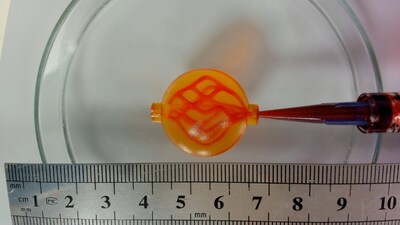
Printing a blood vessel network sounds simple until you consider what the ink has to do: stay soft enough for cells to survive inside it, yet hold a precise channel structure without collapsing under its own weight before it cures.
That tension has shaped bioprinting for years. Recombinant human collagen is the material researchers want: it mimics real human tissue and avoids the disease risk of collagen extracted from animals. The problem is that collagen bioinks have typically been too soft and brittle once printed, losing shape when a complex structure like a vascular channel needs to hold together.
CollPlant's BioFlex addresses that directly. It pairs recombinant human collagen, grown in engineered plants rather than harvested from animals, with a biodegradable polymer and photoactive agents tuned for Digital Light Processing, a process that cures resin layer by layer using projected light instead of a nozzle.
The combination measurably changes what the printed structure can survive: greater tensile strength, more elasticity, less brittleness, and better structural integrity than earlier bioinks, while printing at high resolution and reproducing consistently batch to batch.
That reproducibility matters because vascularization is the bottleneck in growing lab tissue: cells die if they sit more than a fraction of a millimeter from a blood supply. Every bioink that can reliably print a vascular channel is one step closer to tissue, and eventually organs, grown rather than harvested.