500 Parts, 16 Kilograms: How SLS Made WCB Robotics’ Ropeless Facade Cleaner a Production Reality
CategoryLightweight, Series Manufacturing
BranchIndustry
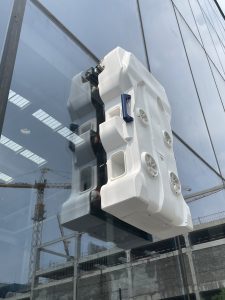
Traditional facade cleaning on high-rise buildings requires workers suspended on ropes, exposed to wind, heat, and fall risk. WCB Robotics developed E.L.M.O., a ropeless facade-cleaning robot that attaches to glass via patented contactless suction and operates autonomously. The design brief was demanding: the robot had to weigh under 16 kilograms, withstand winds up to 100 km/h, and remain functional across environments ranging from 55°C humidity to sub-zero temperatures — all while incorporating over 500 unique components with complex internal flow channels and AI-optimized geometries.
A fully machined version of the robot was estimated to weigh between 30 and 50 kilograms, which ruled out CNC machining as a path to the weight target. Consumer-grade FDM printing was tested but failed on three counts: parts degraded structurally above 45°C, dimensional tolerances were inconsistent across the 500-part assembly, and support removal took up to 9 hours per batch — an unsustainable production overhead for a system heading toward commercial deployment.
WCB Robotics standardized on selective laser sintering with EOS PA 2200 nylon. SLS requires no support structures, which eliminated the post-processing bottleneck and allowed fine features down to 0.5 mm to be produced reliably across every part. The nylon maintained structural integrity at 60°C, well beyond FDM's failure point, and consistent tolerances across all 500+ components were achieved in a single process. Support removal time for a representative part dropped from 9 hours to 30 minutes, manufacturing cost for individual components was up to 5 times lower than machining, and support-related labor across the full system fell by a factor of 18.
The finished robot reached exactly 16 kilograms — a 68% reduction from the machined baseline — and is now deployed commercially across multiple countries, using approximately 1 liter of water per cleaning cycle and operating at around 75 dB