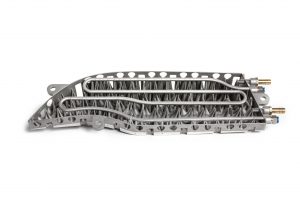
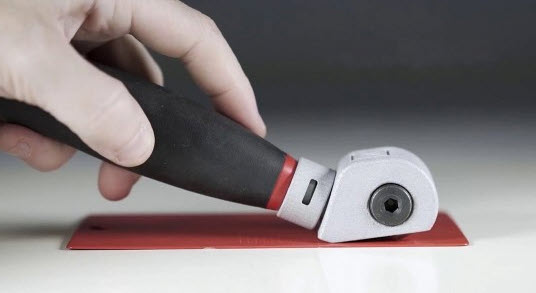
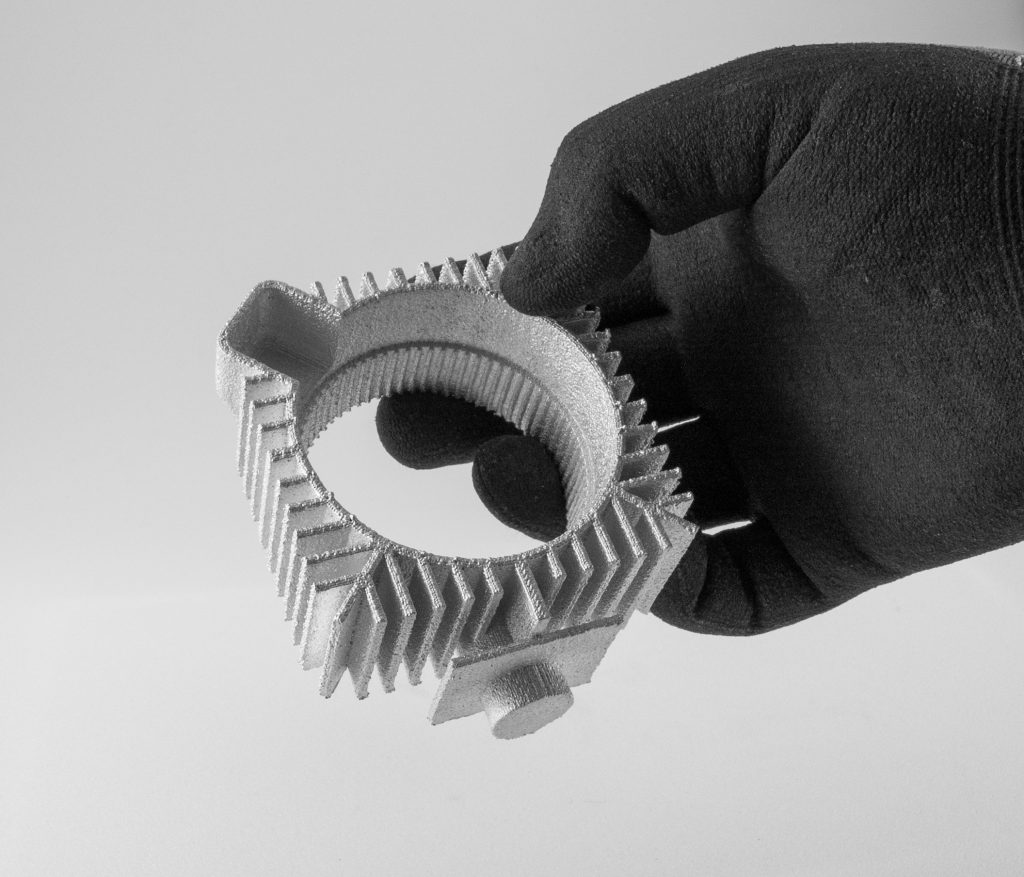
What happens when a metal 3D-printed component is simply too large and complex to produce without an unmanageable volume of support material? For manufacturers working with laser powder bed fusion, support structures are one of the most persistent cost drivers — increasing material consumption, extending post-processing time, and placing practical ceilings on part size and geometric complexity. For a long time, this made large-format metal AM difficult to justify economically.
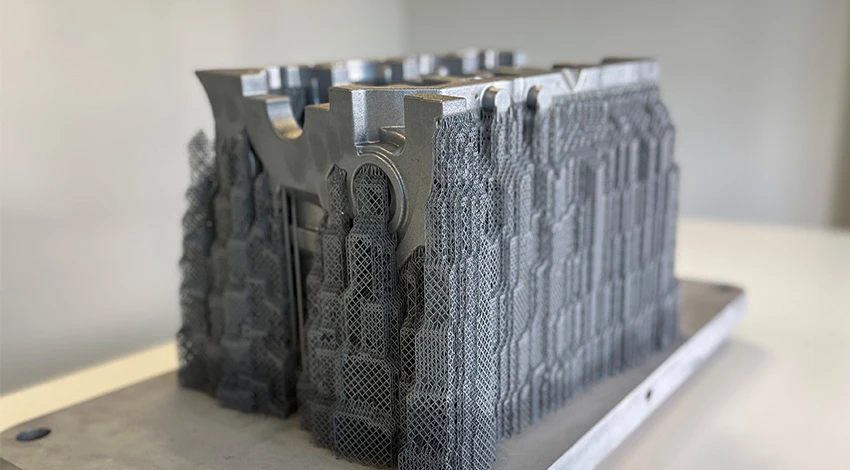
BÖLLINGER GROUP's Department for Additive Manufacturing faced this challenge when tasked with producing an 18-kilogram crankcase — at the time, the largest and heaviest part ever processed with Materialise's e-Stage for Metal+ support generation software. The component was built on a Colibrium Additive X Line 2000R dual-laser system with an 800 × 400 × 500 mm build chamber, pushing the practical limits of what LPBF could deliver at production scale.
Applying e-Stage for Metal+ transformed the support strategy entirely. Instead of dense conventional support volumes, the software generated optimized tree-like structures that contact the part surface minimally. On the crankcase itself, support volume was reduced by 60%. On comparable test builds, reductions of up to 85% were achieved. Data preparation time dropped by 50%, and manual support removal time fell by 45%. The freed build volume allowed panel capacity to increase from 8 to 12 pieces per run, reducing component pricing by approximately €1,000 per part.
This case shows that support optimization is not a post-design detail — it is a core factor in whether large-format metal AM becomes economically viable at production scale. As software-driven strategies continue to mature, components once considered too large or support-intensive to print are entering viable production territory.