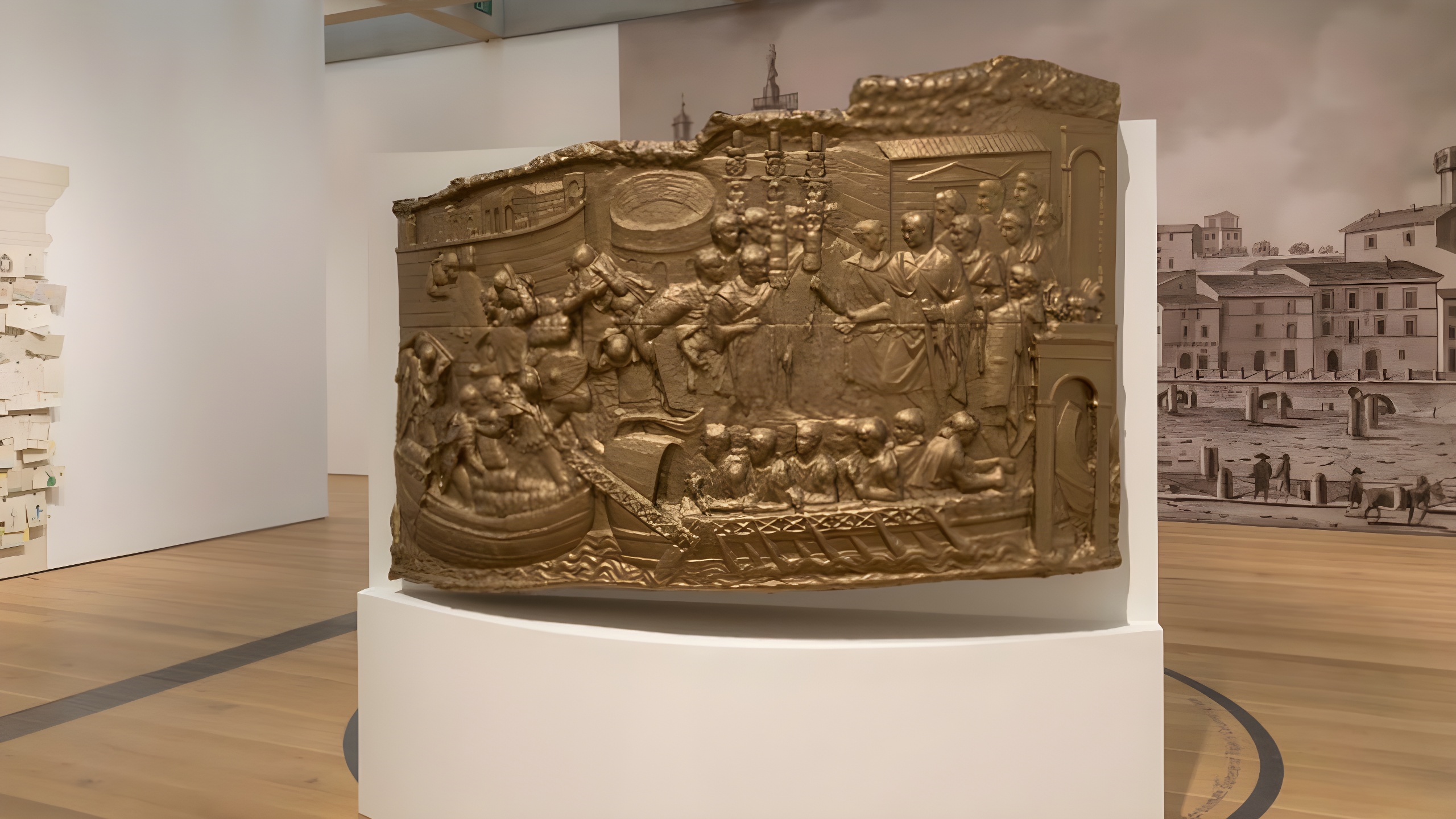
The Saint Louis Art Museum used additive manufacturing to recreate a section of Trajan’s Column, one of ancient Rome’s most iconic monuments, for its exhibition on Emperor Trajan. Since the original 38‑meter marble column in Rome could not be transported, the museum relied on digital scanning and 3D printing to reproduce its intricate bas-relief scenes, which narrate the Dacian Wars in a continuous spiral of detailed carvings.
A digital model of the column was created using advanced capture techniques, and the physical replica was produced by Printerior using a distributed manufacturing approach. Instead of a single printer, a farm of 30 FDM 3D printers operated simultaneously, reducing production time from what would normally take weeks or months to just a few days.
After printing, the segments were assembled and hand-finished with a bronze-like surface to approximate the column’s historical appearance, which may have originally included color and metallic elements. The final replica allows visitors not only to view but also to touch the artifact, something impossible with the original structure, making the experience more interactive and accessible.
Additive Manufacturing can really help bring the essence of historical art back to life.